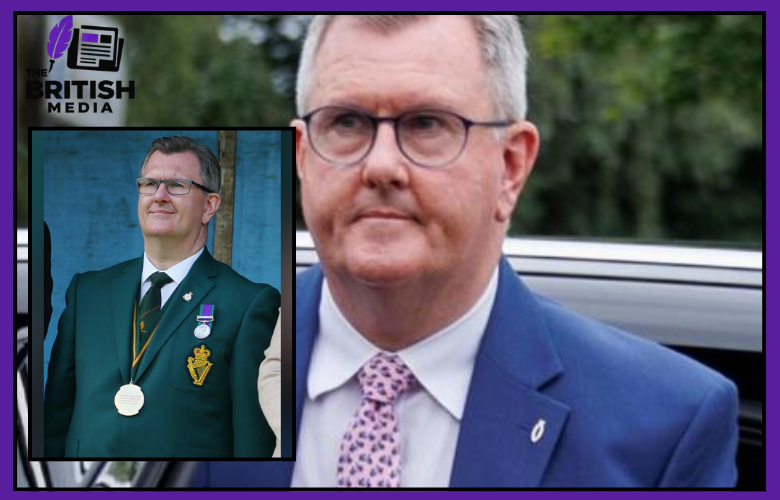
Jeffrey Donaldson is a former Northern Irish politician whose career at Westminster lasted almost 27 years. He became MP for Lagan Valley in 1997, moved from the Ulster Unionist Party to the Democratic Unionist Party in 2004 and eventually became DUP leader in June 2021. His political career covered several defining periods in Northern Ireland, including the post-Good Friday Agreement era, Brexit, the Northern Ireland Protocol dispute and the restoration of Stormont’s power-sharing government in 2024.
His public life changed dramatically in March 2024 when he resigned as DUP leader after being charged with historical seual offences. In June 2026, a Newry Crown Court jury found him guilty of 18 seual offences, including one count of rape, 13 counts of indecent assault and four counts of gross indecency. He is now in Maghaberry Prison awaiting sentencing and is appealing the convictions.
Who Is Jeffrey Donaldson?
Jeffrey Mark Donaldson was born on 7 December 1962 in Kilkeel, County Down. He became involved in unionist politics as a young man and entered elected politics during the Troubles, a period that profoundly shaped Northern Ireland’s political institutions and communities.
His Westminster career began when he was elected MP for Lagan Valley at the 1997 general election. He represented the constituency continuously until 2024, giving him one of the longest parliamentary careers among Northern Ireland’s modern politicians. UK Parliament records show that he was a Commons member from 1 May 1997 until 30 May 2024.
Donaldson was initially associated with the Ulster Unionist Party before becoming an independent unionist for a short period and then joining the DUP in January 2004. He later became one of the party’s most senior Westminster politicians.
Early Life And Education
Donaldson was born and raised in Kilkeel, a town on the County Down coast. His official biographical information lists Kilkeel High School and Castlereagh College among his educational background.
His political involvement began at an unusually young age. In 1985, he was elected to the Northern Ireland Assembly, placing him inside the political system at a time when violence and constitutional disagreement dominated public life.
Before reaching Westminster, Donaldson developed experience through election campaigning and unionist political organisations. Those early years gave him a long association with the political structures that existed before and after the Good Friday Agreement.
That background became important later in his career. Unlike politicians who entered Northern Irish politics after the peace process, Donaldson’s career stretched across both the Troubles and the subsequent period of devolved government.
Jeffrey Donaldson’s Political Career Before The DUP
Donaldson originally belonged to the Ulster Unionist Party. His early political career was closely associated with the party and its leadership during a period of major constitutional negotiations.
He became a Westminster MP in 1997 after winning Lagan Valley. At Westminster, he held a succession of opposition and shadow responsibilities covering areas including defence, home affairs, transport, education, international development and business.
His relationship with the UUP later deteriorated. Donaldson became critical of aspects of the party’s approach to the Belfast Agreement and its implementation. He left the UUP in June 2003, briefly sat as an Independent Unionist and then joined the DUP in January 2004.
The move was an important turning point. It brought Donaldson into the party that would later become a central force in Northern Ireland’s devolved government and Westminster politics.
Why Did Jeffrey Donaldson Join The DUP?
Donaldson joined the Democratic Unionist Party in January 2004 after leaving the Ulster Unionist Party. His move reflected disagreements over the direction of unionist politics and the political settlement that followed the Good Friday Agreement.
The DUP offered Donaldson a different political platform. It was strongly opposed to aspects of the Belfast Agreement and maintained a more uncompromising unionist position on Northern Ireland’s constitutional status.
Once inside the DUP, Donaldson became an important Westminster figure. His previous parliamentary experience meant that he could operate effectively at Westminster while also remaining closely involved in Northern Irish affairs.
He later took on senior party positions, including DUP Chief Whip from 2015 to 2019 and DUP Westminster leader from June 2021 until March 2024.
Jeffrey Donaldson’s Role At Stormont
Although Donaldson is best known nationally as a Westminster politician, he also had experience inside Northern Ireland’s devolved institutions.
He served as a member of the Northern Ireland Assembly from 2003 to 2010. He subsequently held ministerial responsibilities in the Northern Ireland Executive, serving as a junior minister in the Office of the First Minister and deputy First Minister between 2008 and 2009.
His Stormont experience gave him an understanding of the practical difficulties involved in power-sharing between unionist and nationalist parties.
That experience later became relevant during his DUP leadership. Donaldson was involved in negotiations surrounding the restoration of the Northern Ireland Executive after a lengthy period without a functioning devolved government.
When Did Jeffrey Donaldson Become DUP Leader?
Donaldson became leader of the Democratic Unionist Party in June 2021, succeeding Edwin Poots. He also became the DUP’s Westminster leader at the same time.
His leadership was dominated by the consequences of Brexit. The Northern Ireland Protocol created special arrangements for goods moving between Great Britain and Northern Ireland, and the DUP strongly opposed the arrangements.
The party argued that the protocol created an internal UK trade barrier and weakened Northern Ireland’s position within the United Kingdom. Its opposition eventually contributed to the collapse of power-sharing at Stormont.
Donaldson therefore spent much of his leadership trying to secure changes to the post-Brexit arrangements. His position also placed him at the centre of negotiations with successive UK governments.
The Northern Ireland Protocol
The Northern Ireland Protocol became one of the defining issues of Donaldson’s political career. The arrangement was created following Brexit because Northern Ireland shares a land border with the Republic of Ireland, an EU member state.
The protocol sought to avoid a hard border on the island of Ireland while maintaining the EU’s rules for certain goods entering the European single market.
The DUP opposed the arrangement because of its effect on trade between Northern Ireland and Great Britain. Under Donaldson’s leadership, the party maintained pressure on the UK Government to change the arrangements.
The dispute contributed to the prolonged absence of a functioning Stormont Executive. Donaldson subsequently became involved in negotiations that eventually led to the DUP agreeing to return to power-sharing in 2024.
How Did Jeffrey Donaldson Help Restore Stormont?
One of the most important developments of Donaldson’s leadership came in early 2024. After almost two years of political deadlock, the DUP agreed to return to Northern Ireland’s power-sharing institutions.
The agreement followed negotiations with the UK Government over post-Brexit arrangements and measures intended to address unionist concerns.
Stormont was restored in February 2024, with Sinn Féin’s Michelle O’Neill becoming First Minister and DUP politician Emma Little-Pengelly becoming Deputy First Minister.
Donaldson’s involvement in securing DUP support for the agreement represented a significant development in his political career. However, his leadership ended only weeks later.
In March 2024, he resigned as DUP leader following his arrest and charges relating to historical offences.
What Happened To Jeffrey Donaldson In 2024?
On 29 March 2024, Donaldson resigned as DUP leader after being arrested and charged with historical offences. The DUP suspended his membership.
His political career at Westminster also came to an end. Donaldson announced that he would not contest the 2024 general election, ending his representation of Lagan Valley.
Parliament records show that his Commons membership ended on 30 May 2024. His parliamentary affiliation changed to Independent following his resignation from the DUP on 30 March 2024.
The charges concerned alleged offences dating back decades. Donaldson denied the allegations and the case subsequently proceeded to a lengthy trial at Newry Crown Court in 2026.
The court proceedings ultimately resulted in convictions on all 18 charges.
What Was Convicted Of?
In June 2026, a jury at Newry Crown Court found Donaldson guilty of all 18 offence charges. The case involved two women who were children when the offences took place.
The convictions comprised:
- One count of rape
- 13 counts of indecent assault
- Four counts of gross indecency
The offences were committed over a period spanning 1985 to 2008. The jury reached unanimous verdicts after a four-week trial.
Following the verdict, Judge Paul Ramsey remanded Donaldson in custody and indicated that a lengthy prison sentence was inevitable. He was taken to Maghaberry Prison in County Antrim while preparations for sentencing continued.
Donaldson has appealed against the convictions, meaning the case remains subject to a further stage of legal proceedings.
Is Jeffrey Donaldson Still In Prison?
Yes. As of September 2026, Donaldson remains in Maghaberry Prison awaiting sentencing.
A court hearing on 11 September confirmed that submissions from the prosecution and defence are due to be heard on 25 September, with sentencing expected several weeks afterwards in October.
The court has received victim impact reports from the two complainants, who are now adults. Medical reports concerning Eleanor Donaldson, his wife and co-accused, are also being finalised.
The sentencing process is separate from the appeal. Donaldson’s lawyers have already lodged papers seeking to challenge his convictions at the Court of Appeal.
This means his current legal position has three important elements: the 2026 convictions, the forthcoming sentencing hearing and the appeal process.
Is Jeffrey Donaldson Appealing His Conviction?
Yes. Donaldson’s solicitor confirmed in July 2026 that appeal papers had been lodged with the relevant office of the Court of Appeal.
The former DUP leader was convicted unanimously by a jury of seven men and five women after the four-week Newry Crown Court trial. The convictions included rape, indecent assault and gross indecency.
An appeal does not itself erase or overturn the convictions. The Court of Appeal must consider the legal grounds put forward by the defence and determine whether there are grounds for intervention.
As of September 2026, the appeal remains ongoing. The latest court timetable also shows that Donaldson is awaiting sentencing in the meantime.
For readers following the case, this distinction is important because the conviction and appeal are separate stages of the legal process.
What Happened To Jeffrey Donaldson’s Knighthood?
Donaldson was knighted in 2016. Following his convictions, he asked for his knighthood to be forfeited and also resigned from the Privy Council.
His knighthood was subsequently cancelled. A notice published in the Gazette confirmed that King Charles had directed the cancellation and annulment of the honour. His name was also removed from the Privy Council.
The change is significant because the title had been part of Donaldson’s public identity for a decade.
His political and public status has therefore changed substantially since early 2024. He is no longer an MP, no longer leads the DUP, is no longer a member of the Privy Council and no longer holds his knighthood.
What Is The Latest Stormont Review Into?
Following Donaldson’s conviction, reviews were launched to examine whether there had been any previous reports or concerns about his behaviour in political institutions.
A Northern Ireland Assembly review examined his time as an MLA between 2003 and 2010 and his visits to Parliament Buildings while he was an MP. In September 2026, the Assembly said that no relevant information had been identified.
A separate Northern Ireland Civil Service review examined the period from February 2008 to July 2009, when Donaldson held a junior ministerial role in the Executive Office. That review also found no records or disclosures relating to relevant concerns. However, the report stressed that the absence of records or disclosures could not establish that no incident had ever occurred.
These reviews are separate from the criminal case that resulted in his convictions.
What Is The DUP Review Into Jeffrey Donaldson?
The Democratic Unionist Party announced an independent safeguarding review following Donaldson’s conviction.
The review is intended to examine the party’s safeguarding and reporting policies and consider what, if anything, was known within the organisation about concerns relating to Donaldson.
This is separate from the criminal proceedings. The criminal trial examined specific charges brought against Donaldson, while the party review is concerned with organisational procedures and what information may have been available to the DUP.
The distinction matters because a review into institutional handling does not itself determine criminal liability.
The outcome could nevertheless provide information about how political organisations respond to safeguarding concerns and how reporting mechanisms operated during Donaldson’s time in the party.
Who Is Eleanor Donaldson?
Eleanor Donaldson is Jeffrey Donaldson wife. The couple married in 1987 and have two daughters, according to biographical information held by the Northern Ireland Assembly.
She was also a co-accused in the 2026 proceedings. Eleanor Donaldson faced allegations of aiding and abetting her husband’s offending but was found unfit to participate in a conventional criminal trial because of concerns about her mental health.
Instead, a jury conducted a trial of the facts. The jury found that she had committed the acts alleged against her in relation to the charges, but this was a non-criminal process and she could not be convicted or imprisoned as a result.
In September 2026, her legal team lodged an application for leave to appeal that finding.
Family And Personal Life
Donaldson married Eleanor in 1987 and they have two daughters. His official Assembly biography records his marital status and family details.
For much of his political career, Donaldson kept his family life separate from his Westminster and Stormont work. His wife and family became more prominent in reporting because Eleanor was also involved in the later court proceedings.
The criminal case has generated considerable media attention, but there are legal restrictions surrounding the identities of the complainants. Victims of offences have lifetime anonymity unless they choose to waive it, and reporting that identifies them can lead to criminal proceedings.
That makes accuracy particularly important when writing about the case. Personal information that is not officially established or legally reportable should not be presented as fact.
Political Career Timeline
The easiest way to understand Donaldson’s career is through its major milestones:
- 7 December 1962: Born in Kilkeel, County Down.
- 1985: Elected to the Northern Ireland Assembly.
- 1997: Elected MP for Lagan Valley.
- 2003: Left the Ulster Unionist Party.
- 2004: Joined the Democratic Unionist Party.
- 2008–2009: Served as a junior minister at Stormont.
- 2015–2019: Served as DUP Chief Whip at Westminster.
- 2016: Received a knighthood.
- June 2021: Became DUP leader and Westminster leader.
- 2022: The DUP withdrew from Stormont’s power-sharing arrangements.
- Early 2024: Helped negotiate the DUP’s return to power-sharing.
- March 2024: Resigned as DUP leader following his arrest and charges.
- 30 May 2024: Left the House of Commons.
- June 2026: Convicted of 18 offences.
- July 2026: Appeal papers were lodged.
- July 2026: Knighthood was cancelled.
- September 2026: Court confirmed sentencing is expected in October.
This timeline separates his political career from the later criminal proceedings and makes the chronology easier to follow.
Why Was Jeffrey Donaldson Important In Northern Irish Politics?
Donaldson’s importance came partly from the length of his political career. He entered politics in the 1980s and remained active through the transition from the Troubles to the post-Good Friday Agreement political system.
His move from the UUP to the DUP also reflected wider changes within unionist politics. He subsequently became a senior Westminster representative for the DUP and eventually its leader.
During his leadership, the Northern Ireland Protocol became a major political issue. His party’s opposition to the arrangements contributed to the suspension of Stormont, while his later negotiations helped facilitate the DUP’s return to power-sharing.
That combination makes his career relevant to anyone studying Northern Ireland’s recent political history. However, his political career should be distinguished from the criminal case that followed his resignation in 2024.
Is It Worth Reading About Jeffrey Donaldson?
For readers researching Northern Irish politics, Jeffrey Donaldson’s career provides a useful route through several major political developments. His journey from young unionist politician to long-serving MP and DUP leader spans the Troubles, the Good Friday Agreement era, Brexit and the restoration of Stormont.
His biography is also important because his current public status is very different from his position only a few years ago. He is no longer an MP or DUP leader, and his knighthood and Privy Council membership have ended.
The latest information is particularly important. He was convicted of 18 offences in June 2026, remains in custody awaiting sentencing and has lodged an appeal.
For an accurate article, the strongest approach is to keep his political record, criminal conviction, appeal and current court timetable clearly separated rather than combining different periods of his life into one narrative.
Also Read:Romesh Ranganathan Wife Leesa and Their Life Away From Fame
Frequently Asked Questions
Who is Jeffrey Donaldson?
Is a former Northern Irish politician who served as MP for Lagan Valley from 1997 to 2024. He joined the DUP in 2004 and became its leader in June 2021.
When was Jeffrey Donaldson DUP leader?
He was DUP leader from June 2021 until March 2024. He resigned after being arrested and charged with historical offences.
Is still an MP?
No. He left the House of Commons on 30 May 2024 after deciding not to contest the 2024 general election. Parliament records his Commons membership from 1997 to 2024.
What was Jeffrey Donaldson convicted of?
He was convicted in June 2026 of 18 offences involving two women who were children at the time. The convictions included one count of rape, 13 counts of indecent assault and four counts of gross indecency.
Is appealing?
Yes. His solicitor confirmed in July 2026 that appeal papers had been lodged with the Court of Appeal. As of September 2026, he remains in custody awaiting sentencing.
Conclusion
Life and career cover almost four decades of Northern Irish political history. He entered politics during the Troubles, became Lagan Valley MP in 1997, moved from the UUP to the DUP and eventually became leader of the Democratic Unionist Party in 2021. His political career was closely connected to unionist politics, Brexit, the Northern Ireland Protocol and the restoration of Stormont’s power-sharing government in 2024.
That career ended abruptly in March 2024 following his arrest and resignation as DUP leader. In June 2026, a jury at Newry Crown Court convicted him of 18 offences. He is currently held in Maghaberry Prison awaiting sentencing, with the latest court timetable pointing to October 2026. He has also lodged an appeal against his convictions.
For anyone searching for Jeffrey Donaldson today, the key is to use an up-to-date timeline and distinguish his former political career from the ongoing legal process.