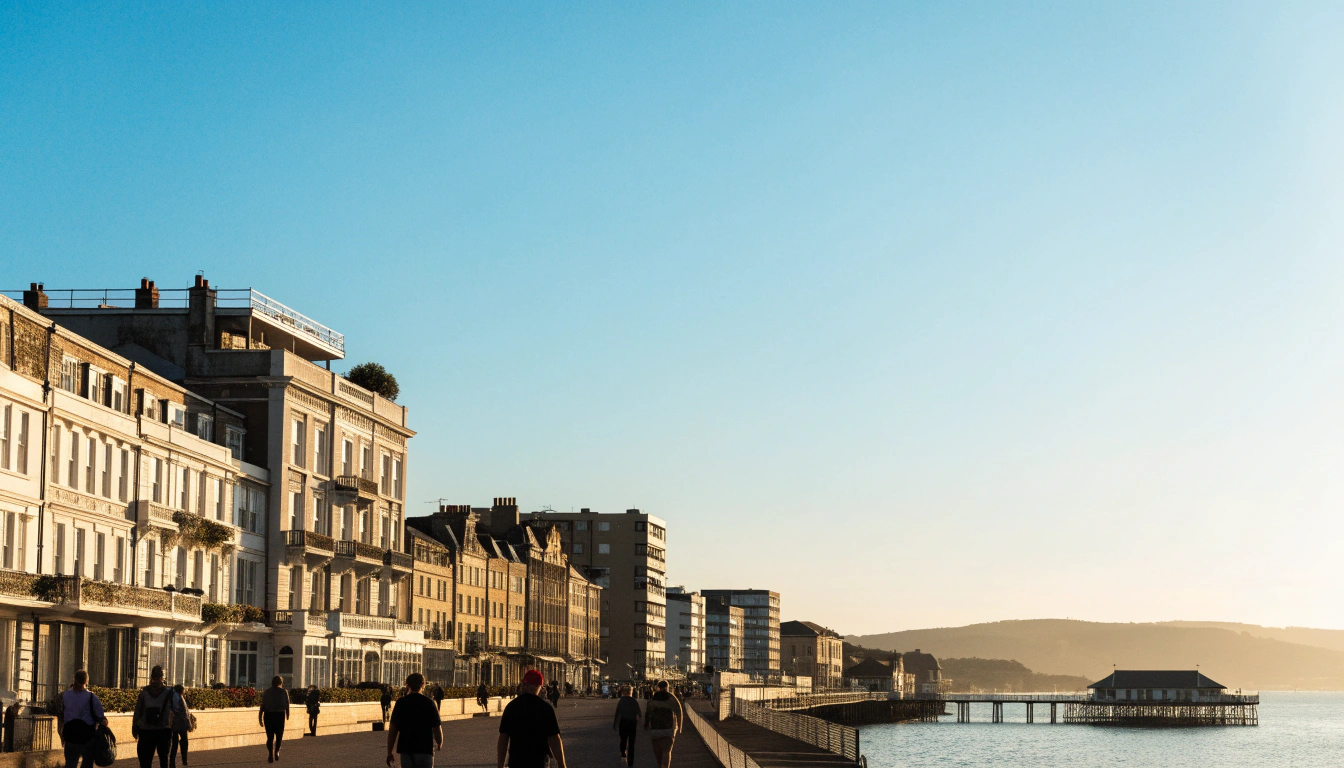
Ask anyone who’s lived in Worthing for twenty years what’s changed and they’ll probably mention the coffee. There’s more of it, better made, served to people who would once have bought in Kemptown or Hove without thinking twice. If you’re one of those buyers and you’re wondering whether the town will hold its value, I’d start by talking to local estate agents in Worthing for buyers before you look at a single listing, because the sales that never reach the portals often tell you more than the ones that do.
That advice sounds obvious, I know. But Worthing is a town people misjudge from a distance, usually by assuming it’s either a sleepy retirement spot or a budget version of Brighton. Neither label helps much if your real question is what the place will be worth in fifteen years, and the truth sits somewhere in between, which is more encouraging than either stereotype suggests.
Why the Brighton Comparison Only Gets You Halfway
Brighton matters here, and it’d be silly to pretend otherwise. The train between the two takes around twenty minutes on the West Coast way line, so for a lot of buyers Worthing has been the answer to a simple problem: they wanted the sea, they couldn’t afford Hove, and they weren’t ready to give up on the coast entirely. That kind of demand is real, though it’s also a little fickle.
What steadies things is that Worthing doesn’t live on Brighton’s spare change. Worthing Hospital employs a large workforce, GSK has run its manufacturing site in the town for decades, and there’s the council, the schools, the care sector and a long tail of small businesses on top. I’d take a town with its own payroll over a pure commuter suburb any day, because when trains get cut or offices recall staff, people still need to get to work locally.
The Commute, Honestly Assessed
London is doable rather than easy. Direct services into Victoria usually take around an hour and a half, which most people can live with a couple of days a week and almost nobody enjoys five. Gatwick’s roughly an hour away by rail, handy if you fly for work or have family overseas.
So why do London workers keep moving here? Hybrid working is most of the answer. Once the office becomes a Tuesday and Thursday arrangement, the maths shifts, and a slower journey starts to look like a fair price for a garden, a bit more floor space and a seafront that isn’t wall to wall with stag parties.
Driving is the sorer subject. The A24 north towards Horsham is fine, but the A27 through Worthing and Lancing is a daily headache that successive improvement schemes have failed to sort out. If your job means driving east or west at peak times, do the journey for real before you make an offer, because it can change which end of town makes sense.
Street by Street, Not Town by Town
Prices in Worthing don’t move as one block, and the gap between neighbourhoods is wide enough to matter for long-term planning. Goring-by-Sea has the calm, settled feel of somewhere people retire to and then refuse to leave, with detached homes, wide roads and its own station. Turnover there is low, which tends to protect values.
Tarring’s different again. Its conservation area around the High Street keeps a village atmosphere, the period cottages rarely hang around long once listed, and West Worthing station is a short walk. Broadwater, meanwhile, is where a lot of young families end up, partly for the Victorian and Edwardian terraces and partly because the schools and transport do the job without Goring’s price tag. East Worthing, closer to Lancing, usually offers a cheaper way in, though it’s patchier from one street to the next.
Up towards the Downs, Findon Valley and High Salvington offer bigger plots and views across the national park, and buyers pay for that space. Heene, near the seafront, has some lovely older buildings too. It’s the town centre flats I’d be more cautious about, not because they’re bad homes but because flats generally appreciate more slowly than houses, and leasehold costs can quietly eat into whatever gain you do make.
Flood Maps, Stalled Sites and a Natural Ceiling
Any seaside purchase deserves a look at the Environment Agency’s flood maps, and Worthing is no exception. Most of the town isn’t high risk, yet streets close to the front or in lower pockets are worth checking, and I’d get an insurance quote before exchange rather than discovering the premium afterwards.
Then there’s regeneration, which in Worthing has a slightly weary reputation. The Teville Gate site by the station sat untouched for years and became local shorthand for plans that never quite arrived, and the town centre has suffered the same retail drift seen almost everywhere. Improvements may well come. But paying extra now for something that hasn’t been built is rarely a good long-term habit.
The point that gets overlooked, and arguably the strongest one, is geography. Worthing has the Channel on one side and the South Downs on the other, so there simply isn’t much land left to build on, and limited supply tends to hold prices up through slower years. It won’t protect anyone from a sharp rise in mortgage rates, but it gives the market a floor that plenty of sprawling inland towns don’t have.
Final Thoughts: Buying Into a Town Mid-Change
What makes Worthing interesting for long-term buyers is that it hasn’t finished becoming whatever it’s going to be. The shift from retirement town to a mixed, younger community is visible on the high street and at the school gates, but it isn’t complete, and places caught halfway through that sort of change tend to reward people who arrive early and stay put.
I suspect the next ten years will hinge less on national house prices and more on whether the regeneration sites finally get built and whether hybrid working sticks. If both go Worthing’s way, today’s buyers will look sensible in hindsight. If they don’t, a well-chosen house in Tarring or Goring will still be a good place to live, which is, frankly, not the worst fallback for any property decision.