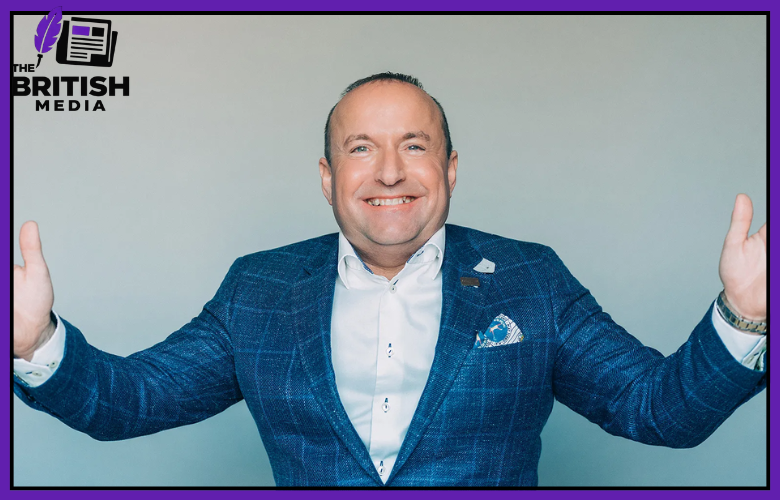
Dave Fishwick is a British entrepreneur, businessman, author and philanthropist best known for the Bank of Dave story. Born in Nelson, Lancashire, in March 1971, he left school at 16 without qualifications before building a successful career in the motor trade. His minibus business eventually became one of Britain’s leading suppliers.
His career changed direction after the 2008 financial crisis. Some of his customers struggled to obtain finance from traditional banks, so Fishwick began lending his own money to help them. That experience inspired Burnley Savings and Loans and eventually turned him into a national television figure.
His story has since appeared in a Channel 4 documentary series, a Sunday Times bestselling book, two Netflix films and a stage musical. In 2026, he was also appointed an Officer of the Order of the British Empire for services to finance, business and charity.
Who is Dave Fishwick?
David Fishwick is an entrepreneur from Nelson, Lancashire, who became famous for combining business with a community-focused approach to finance. His name became closely connected with Burnley Savings and Loans, the company popularly known as the Bank of Dave.
His early career was very different from conventional banking. After leaving school at 16, he began buying and selling cars while working as an apprentice builder. He later moved into vans and minibuses and eventually established his own garage.
That business background became important to his later financial venture. Fishwick understood the difficulties faced by small businesses because many of his own customers depended on vehicle finance. When traditional lenders became more cautious after the financial crisis, he saw an opportunity to provide an alternative source of funding.
How old is Dave Fishwick?
Dave Fishwick was born in March 1971 in Nelson, Lancashire. He is 55 years old in September 2026.
His background is often discussed because he achieved substantial business success without following a university or traditional corporate route. He left school at 16 with no qualifications and started working before developing his own businesses.
His age also places his career across several major changes in British business and finance. He built his original company before the financial crisis, launched Burnley Savings and Loans after the crisis and later became a familiar television and film personality.
How did make his money?
Fishwick made his original fortune through entrepreneurship, particularly the sale of cars, vans and minibuses. His official biography says he started buying and selling cars while working as an apprentice builder. He gradually moved into commercial vehicles after recognising the potential of the market.
By 1994, he had bought his own garage. His vehicle business later developed into David Fishwick Van and Minibus Sales, which supplies minibuses and light commercial vehicles to organisations including schools, sports teams, community groups and local authorities.
His wider business interests have also included property, commercial vehicle parts and investments. In a 2024 interview with The Times, Fishwick said he had six businesses, including an investment company, media business, property business, leasing business, vehicle business and Bank of Dave.
What is Bank of Dave?
Bank of Dave is the popular name associated with Burnley Savings and Loans, the financial venture established by Fishwick in Burnley.
The idea developed after the financial crisis of 2008. Fishwick said that some of his minibus customers could no longer obtain loans from traditional banks even though he believed they remained capable of repaying them. He began lending his own money to customers and later decided to develop the idea further.
The business became the subject of Channel 4’s Bank of Dave documentary series in 2012. Fishwick’s aim was to create a more community-focused financial model, with profits going to charitable causes. His own biography says he started the venture with his own money and did not intend to take a large salary or bonus from it.
Is Bank of Dave a real bank?
The answer requires some context because “Bank of Dave” is a popular name rather than simply the legal name of the business.
The venture is associated with Burnley Savings and Loans. Contemporary reporting explained that “Bank of Dave” was the slogan used by the business while the company operated under its proper financial and regulatory arrangements.
The story became complicated because taking deposits and operating as a fully licensed bank involve substantial regulatory requirements. Fishwick’s original campaign focused heavily on those challenges.
This distinction also matters when watching the Netflix films. The films are based on real events but dramatise aspects of Fishwick’s story. They should therefore be viewed as entertainment inspired by his experiences rather than as a precise documentary record.
Why did Dave Fishwick become famous?
Fishwick became nationally recognised when Channel 4 followed his attempt to establish a community-focused financial business in Burnley.
The 2012 programme showed his efforts to provide loans to businesses that had struggled to obtain finance from traditional lenders. His unusual approach, direct personality and determination to challenge established financial practices made the programme distinctive.
The television success led to further programmes, including Fighting The Fat Cats, David Fishwick: Loan Ranger and The Shopper’s Guide to Saving Money.
His story also became a book titled Bank of Dave: How I Took on the Banks. Search results identify the book as a Sunday Times business bestseller.
What business did Dave Fishwick own before Bank of Dave?
The minibus business was the foundation of Fishwick’s entrepreneurial career. His route into the industry began with used cars before he recognised that commercial vehicles offered greater opportunities.
According to his official biography, he bought a run-down van, repaired it and sold it. That experience convinced him that there was significant potential in vans and minibuses. He continued developing the business until he bought his own garage in 1994.
David Fishwick Van and Minibus Sales subsequently became a major part of his business profile. The company supplies customised minibuses and commercial vehicles across the UK.
This history helps explain why his financial venture began with lending to vehicle customers. He was already familiar with the financing problems faced by small businesses before he became involved in the banking debate.
Dave Fishwick wife and family
Is married to Nicky Fishwick. His wife has been mentioned in public accounts of his career, and Fishwick has credited her and his business team with supporting his work. ITV reported in 2026 that he credited his wife Nicky, David Henshaw and the wider Bank of Dave team as important parts of his continued success.
Fishwick has generally kept much of his private family life away from the centre of his public career. The Times reported in 2024 that he and Nicky have two grown-up children.
Most reliable coverage focuses on his businesses, charitable work, television career and financial campaign rather than detailed information about his family.
Dave Fishwick net worth
There is no reliably verified public figure for Current personal net worth.
Some websites publish estimated figures, but online estimates should not be treated as confirmed unless they are supported by financial records or a direct statement from Fishwick himself. His businesses have generated substantial commercial activity, but company turnover is not the same as personal wealth.
His official speaker profile describes him as a multi-millionaire and identifies his minibus company as a major source of his business success.
Fishwick has also built interests outside the vehicle industry, including property and investment businesses. The Times reported that he has been involved in several businesses and that he prefers not to give a precise figure when asked about his wealth.
For this reason, a specific online net-worth number should be treated as an estimate rather than established fact.
What happened to Dave Fishwick after the original Bank of Dave?
The original Channel 4 programme was only the beginning of Fishwick’s media career.
His story later inspired the Netflix film Bank of Dave, with Rory Kinnear playing a fictionalised version of the entrepreneur. A second film, Bank of Dave 2: The Loan Ranger, followed in 2025 and drew on his campaign against high-cost lending. ITV reported in 2026 that both films were based on his real-life work and investigations into loan sharks.
His story has now moved beyond television and film. Bank of Dave: The Musical opened in 2026, with the production based on the bestselling book, documentary and Netflix film. The Lowry described it as a new British musical inspired by Fishwick’s story.
His public career therefore now covers business, finance, television, publishing, film and theatre.
What is Dave Fishwick doing now?
In 2026, Fishwick remains active in business, financial campaigning and public speaking.
ITV reported that he was continuing his campaigning and money advice work while also serving as an ambassador for community banks in the United States.
Another major milestone came in the 2026 King’s Birthday Honours. Fishwick was appointed an OBE for services to finance, business and charity. He described the honour as a significant moment and continued to emphasise self-belief and determination when discussing his career.
His continuing public work shows that the Bank of Dave story has developed into a broader career focused on entrepreneurship, financial access and charitable giving.
What can entrepreneurs learn from Dave Fishwick?
Fishwick’s career contains several clear business themes:
- Start with a practical opportunity: His career began with buying and selling vehicles.
- Understand customers: His experience with minibus buyers helped him recognise problems with business finance.
- Build gradually: His career developed from individual vehicle sales into a larger commercial operation.
- Look beyond one industry: He later moved into finance, property, investment and media.
- Create a recognisable story: The Bank of Dave concept translated a complex financial issue into an accessible public story.
- Use different platforms: Television, books, film and theatre have all expanded the reach of his business story.
- Separate reputation from evidence: His career also demonstrates why business claims, wealth estimates and entertainment adaptations should be checked against reliable sources.
These lessons do not guarantee entrepreneurial success. Market conditions, regulation, financing and individual circumstances all affect business outcomes.
Dave Fishwick book and television career
Fishwick’s book Bank of Dave: How I Took on the Banks became an important part of his public profile. Search results identify it as a Sunday Times business bestseller.
His television career developed around money and business. The original Bank of Dave series appeared in 2012, followed by programmes dealing with financial issues and consumer spending.
The later Netflix films introduced his story to another international audience. Rory Kinnear portrayed Fishwick in the films, which use his real-life experiences as the foundation for fictionalised stories.
In 2026, the story reached the stage through Bank of Dave: The Musical. The Lowry says the production is based on the bestselling book, BAFTA-winning documentary and global Netflix film.
Is worth reading about?
Fishwick’s career is relevant to readers interested in entrepreneurship, small businesses, financial services and community finance because his professional journey crosses several different areas.
He started without formal qualifications, developed a commercial vehicle company and then entered financial services after seeing problems affecting his own customers. That combination makes his story different from a conventional banking career.
His public profile also provides an example of how one business story can develop across multiple forms of media. The original documentary became a book, then a Netflix film series and eventually a musical.
For anyone researching him, however, it is useful to distinguish documented events from dramatised entertainment. The real business history is more detailed than the version presented on screen.
frequently asked questions
How did Dave Fishwick become rich?
His original business success came from buying and selling vehicles, particularly vans and minibuses. He later expanded into other business interests, including property and investments.
Is Bank of Dave still operating?
Bank of Dave is the popular name associated with Burnley Savings and Loans. Its financial activities and regulatory status should be distinguished from the fictionalised version shown in Netflix films. Contemporary reporting has described it as a regulated lending company rather than simply assuming that the popular name means a conventional high-street bank.
Who is Dave Fishwick’s wife?
wife is Nicky Fishwick. Public reporting has also stated that the couple have two grown-up children.
Is the Bank of Dave story true?
The central story is based on Fishwick’s real business and financial campaign. However, the Netflix films dramatise events and characters, so they should not be regarded as a scene-by-scene factual account.
Conclusion
Dave Fishwick’s story combines entrepreneurship, financial services, television and philanthropy. From leaving school in Nelson at 16 without qualifications, he built a successful minibus business before becoming involved in community lending after the financial crisis. His experience with customers who struggled to obtain finance helped inspire Burnley Savings and Loans and the Bank of Dave story.
The story has since developed far beyond the original Channel 4 documentary. Fishwick became an author, television personality and the subject of Netflix films, while his experiences have now been adapted into a stage musical. In 2026, he received an OBE for services to finance, business and charity.
For readers researching his age, wife, family, business, net worth or Bank of Dave, the most useful approach is to separate confirmed information from online estimates and fictionalised film details. That gives a clearer picture of the businessman behind one of Britain’s most recognisable modern business stories.